Casa del Pingone: Inside Turin’s Most Authentic Boutique Hotel
Casa del Pingone: the Most Authentic & Exclusive Stay in Italy’s Most Underrated City
A 15th-century Renaissance palazzo, six intimate suites and a rooftop terrace over the Duomo. This is where you stay in Turin if you want to truly live the city.
- Why stay: Authentic. Historical. Genuinely singular. The perfect stay if you want to truly live the city, not just visit it
- Stay: six suites inside a 15th-century Renaissance palace, restored with architectural precision and genuine local character
- Highlight: Penthouse N°33 — a 150 m² private apartment with a rooftop terrace overlooking the Duomo of Turin
- Services: boutique B&B with an in-house restaurant, specialty coffee bar and private dining in a Renaissance palazzo
- Address: Via Porta Palatina 23/B, Turin, Italy
- Official website: Casa del Pingone
Casa del Pingone is not a hotel. It is not a serviced apartment. It is something rarer: a family with deep roots into the city of Turin brought this stunning 15th-century palazzo back to life. It is a very exclusive stay with only 6 rooms, a scale that allows the host to give each guest appropriate attention.
The building dates to the XV century. The owner is a talented local architect who restored the Palazzo with the precision and the instinct of someone who understands that the most important detail in any room is the story behind it.
This is a local gem, hidden in plain sight in the heart of Turin’s oldest quarter.
The Location — Turin’s Most Ancient Quarter
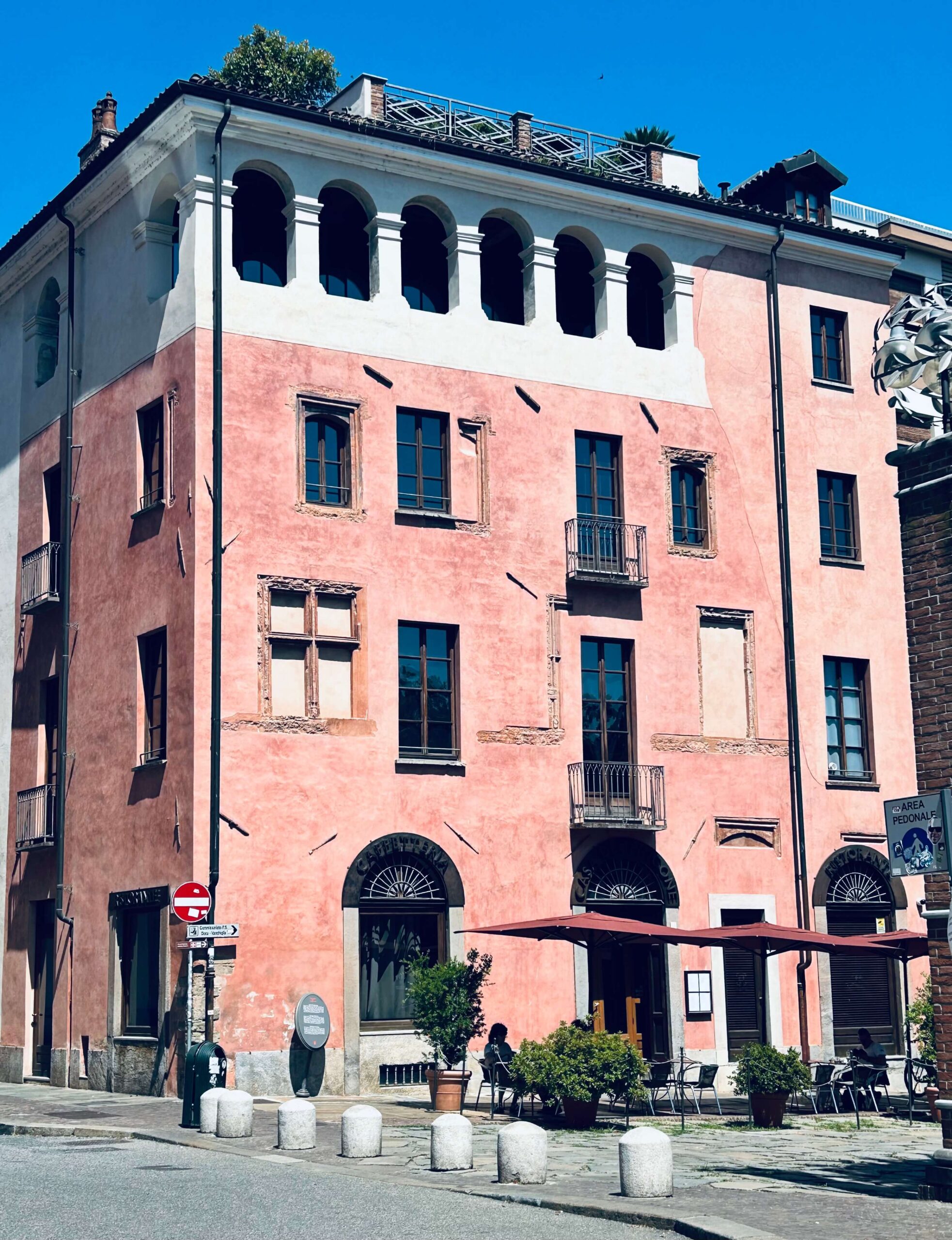
Casa del Pingone sits in the Quadrilatero Romano, the oldest urban grid in Turin — a neighbourhood laid out by the Romans over 2,000 years ago and still, remarkably, shaped by those original streets.
It is a lively, characterful district of independent wine bars, morning markets and trattorias known mainly to locals.
The house itself is tucked into one of its quietest corners: a small, colourful facade that most visitors walk straight past.
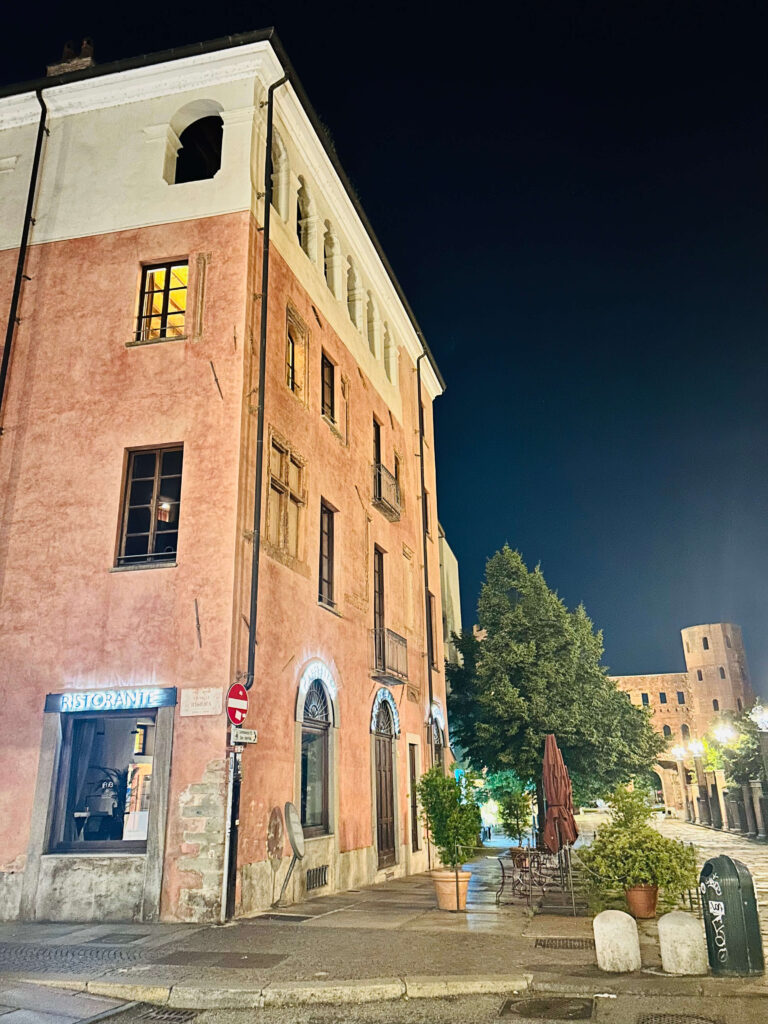
Just a few steps from the front door, stand the Porte Palatine: a 1st-century BC Roman gate, one of the best-preserved in the world, which once marked the northern entrance of Turin (at the time the city was a Roman colony and it was known with the name of Augusta Taurinorum).
The contrast is quietly extraordinary — you step out of a Renaissance house and into an ancient city.
For a ten-second glimpse of the Palatine Gates:
What makes the position so well-judged is the balance between access and calm.
You are a short walk from the Duomo of Turin, from Largo IV Marzo with its café terraces and from the covered market of Porta Palazzo — one of the largest open-air markets in Europe.
And yet the immediate street is almost entirely free of traffic, with the kind of stillness that is increasingly difficult to find at the centre of any major city.
The History Behind Casa del Pingone
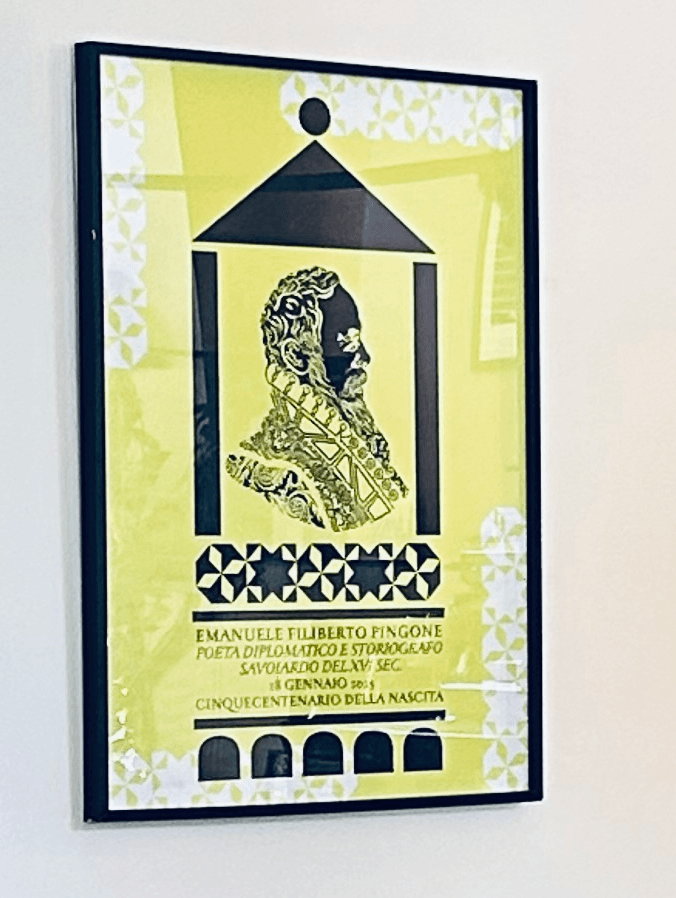
The house was built in the late 15th century and takes its name from Emanuele Filiberto Pingone: historian, magistrate, diplomat and official court historian to the Duke of Savoy — one of the most powerful rulers in Renaissance Europe. It was his family’s private residence, and the building still carries the quiet authority of that original purpose.
Pingone was born in Chambéry in 1525 into a noble family distinguished enough to be admitted to the Order of Malta. After studying in Lyon, Paris, Annecy and Padova, he settled in Turin when the city became the capital of the Duchy of Savoy — and later of the Kingdom of Sardinia. The building where he worked and lived has outlasted empires.
The Interior: Restaurant, Café & Event Spaces
The property has been restored with a sure aesthetic hand — original frescoes and 16th-century wooden ceiling beams kept intact, set against carefully chosen contemporary art and lighting. The effect is neither museum nor design hotel: it feels lived in, considered and deeply personal. The food and drink offering is central to the experience.
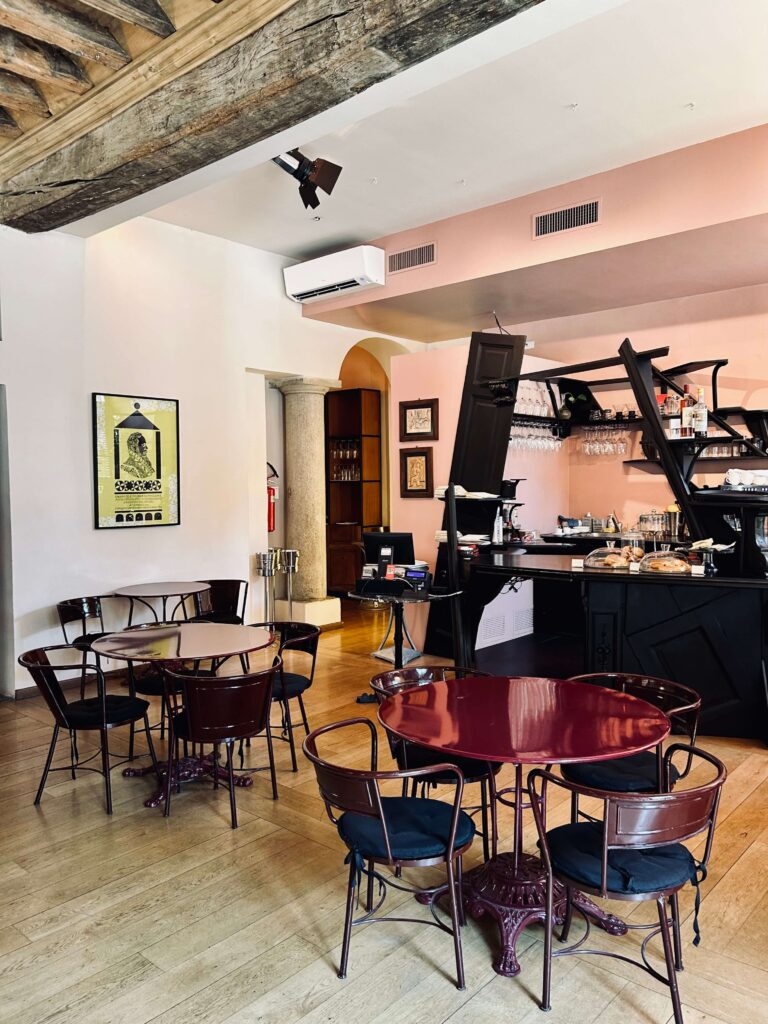
The ground-floor coffee bar offers a carefully curated selection of “specialty coffees” — a natural place to start the morning slowly, or to retreat to in the afternoon with a book.
In the evenings it transitions into an aperitivo bar with a character that is entirely its own: intimate, unhurried, accompanied by well-made cocktails and, more often than not, good conversation.
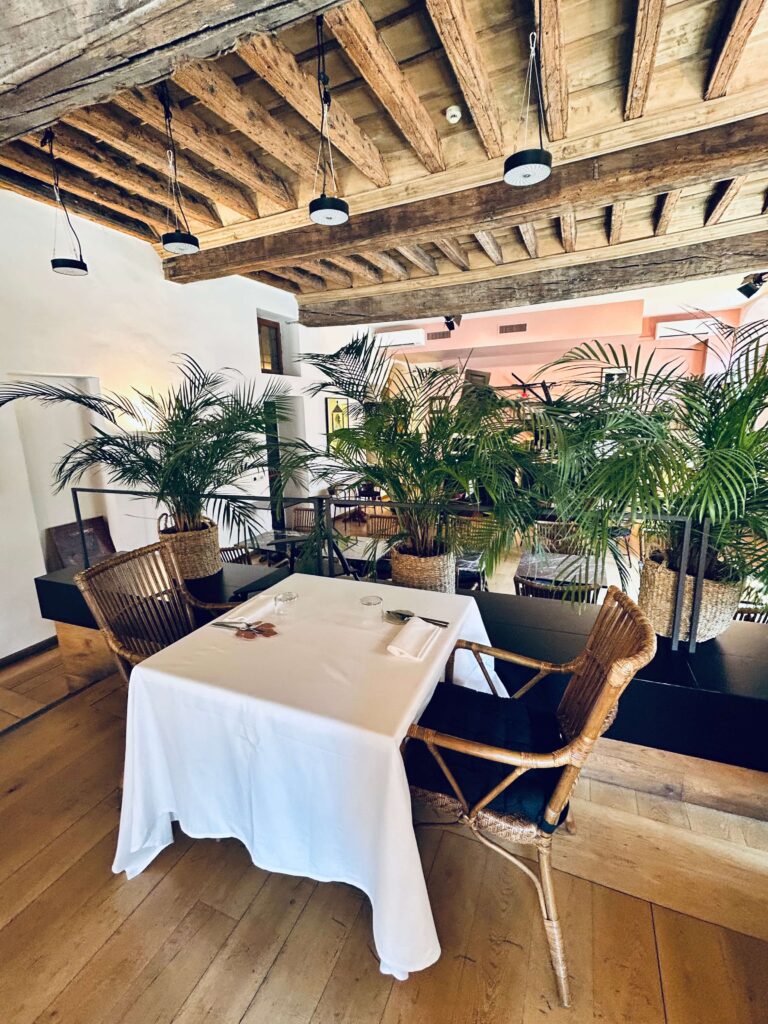
The restaurant serves lunch and dinner in a room where tables are generously spaced — a detail that matters more than it sounds.
The young Piedmontese chef’s cooking is rooted in Piedmontese tradition and expressed with originality: Carmagnola pepper served with Roccaverano goat’s cheese gelato — a dish that places two of the region’s finest protected-origin ingredients in unexpected, elegant conversation.
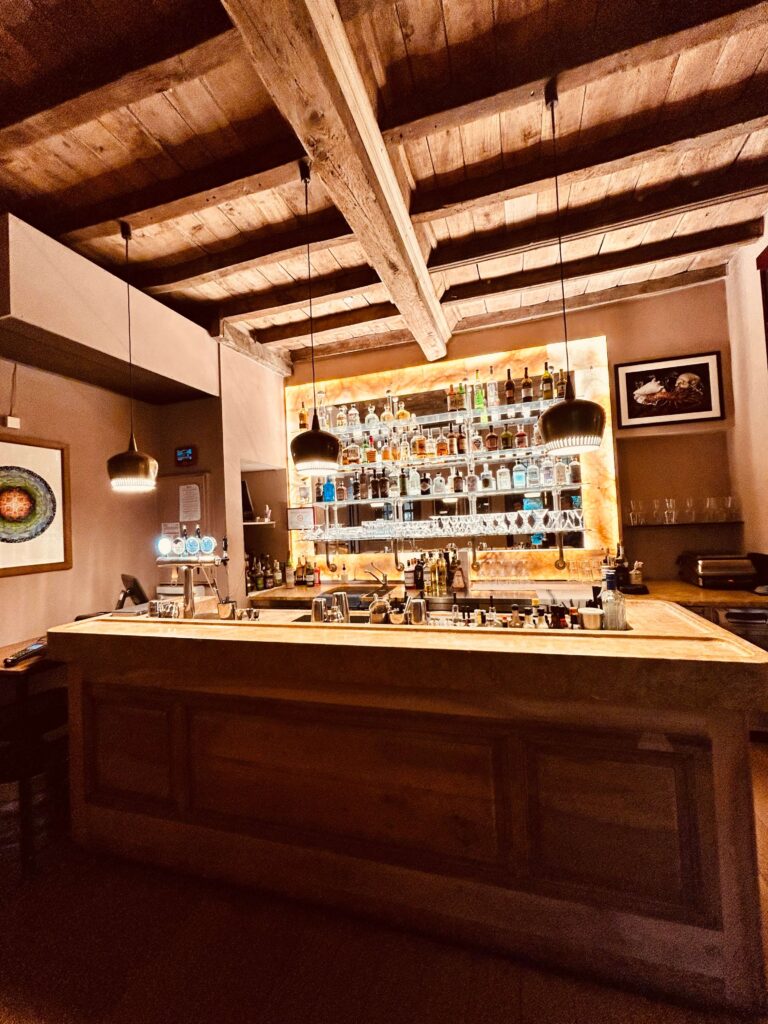
The property holds also an American Bar, which is just the perfect place to wind down after a long day visiting the city. The centrepiece of the bar area is a remarkable carved wooden counter — the kind that takes a craftsman years and that no contemporary fitout can replicate.
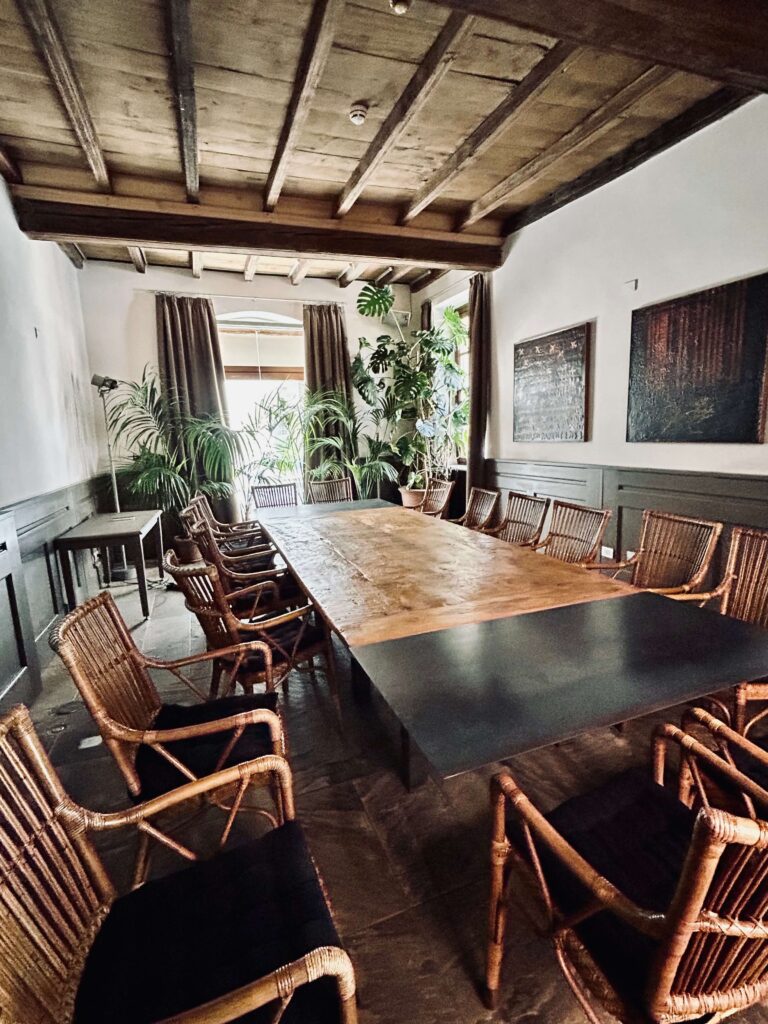
For those who travel for work as well as pleasure, Casa del Pingone offers a private meeting room seating 15 to 20 people around a substantial wooden table, with good connectivity and the kind of atmosphere that makes a working session feel less like an obligation.
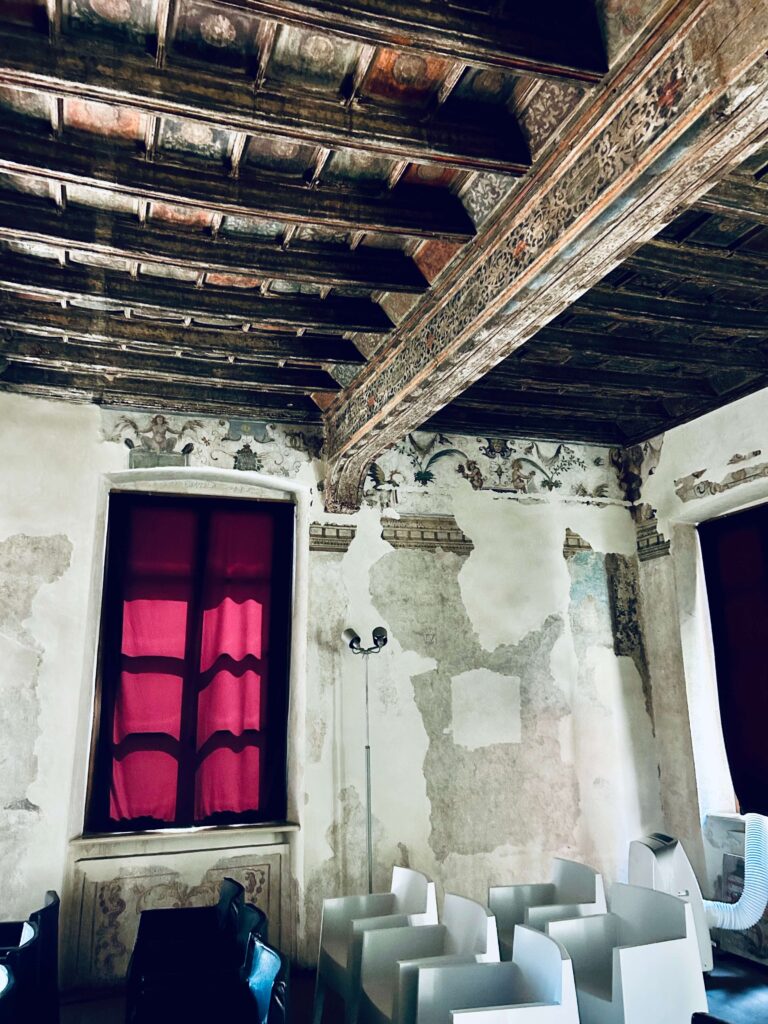
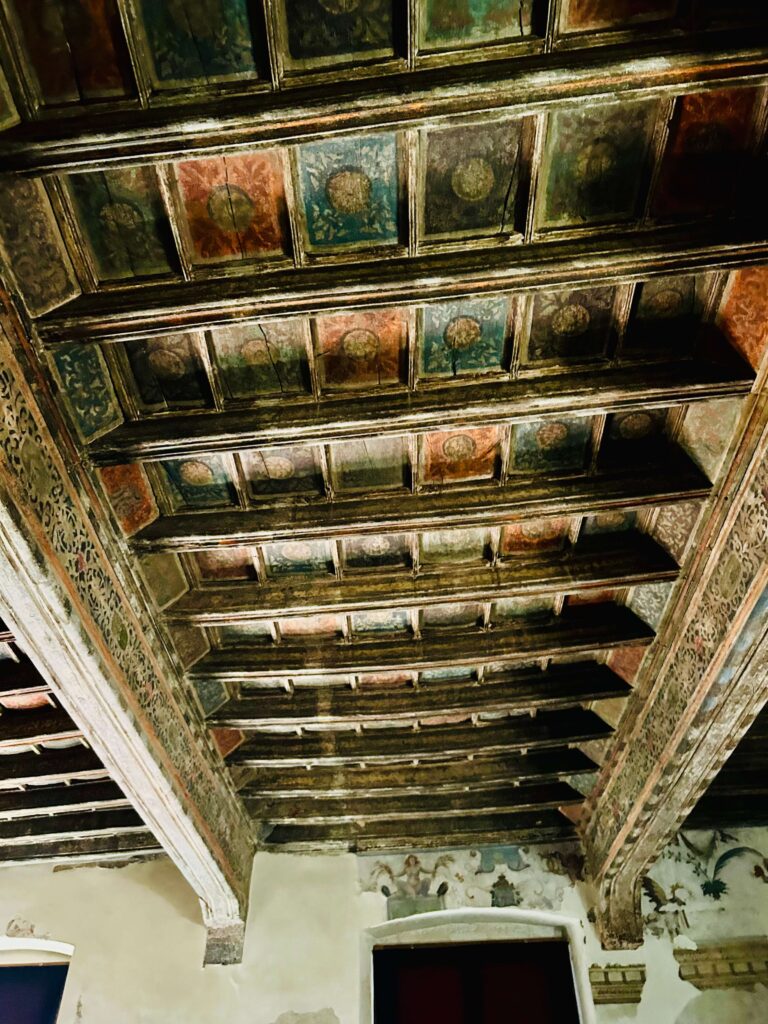
The larger event space — capable of hosting 50 to 100 people for presentations or private dinners — is the most architecturally extraordinary room in the building.
Original 16th-century frescoes cover the walls. The exposed timber beams are those that Emanuele Filiberto Pingone would have looked up at. There is no contemporary event space in Turin — perhaps in Italy — that offers this particular quality of historical weight combined with practical functionality.
The Rooms
Six suites. That number is deliberate. At this scale, a property can afford to give each guest genuine attention. This is true luxury.
Every room has been individually designed, drawing on the building’s original proportions and character rather than imposing a uniform aesthetic on them.
The decorative choices are precise throughout: nothing mass-produced, nothing arbitrary. Each room holds its own quiet story.
Camera Superior 10
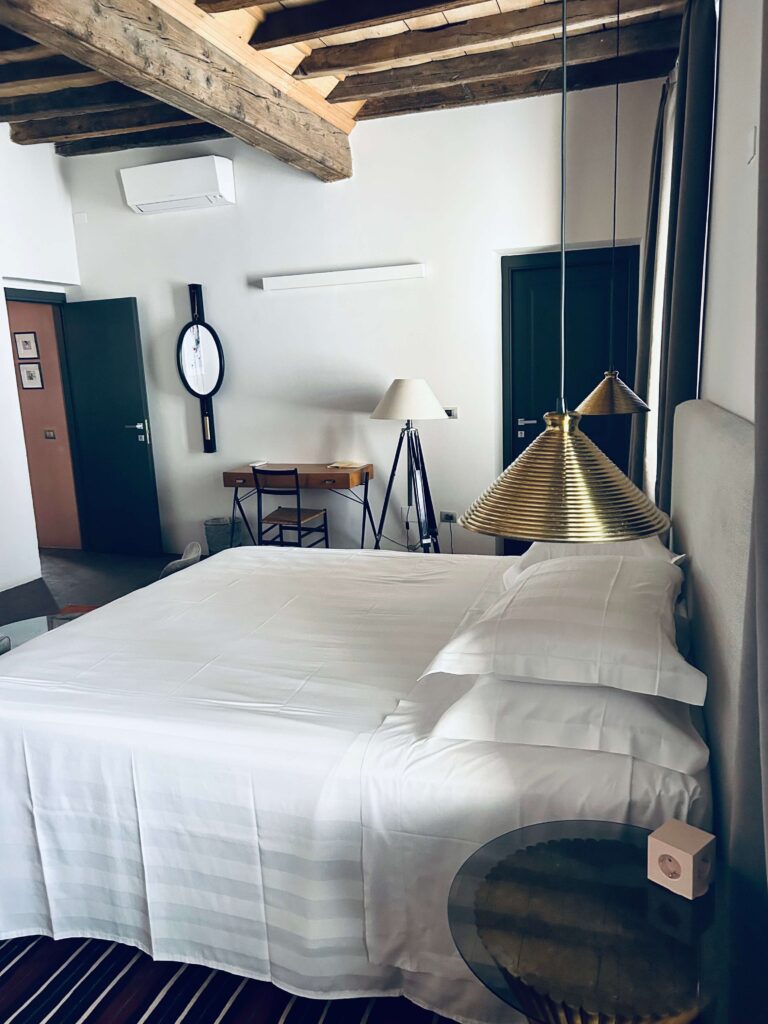
The entry-level room – called Camera Superior 10 – is worth describing in some detail, because it resets expectations of what “entry-level” can mean.
At 43 square metres, the room is significantly larger than many city-centre hotel suites.
The king-size bed is positioned to face the inner courtyard, from which no street noise reaches. Ceiling-mounted bedside lamps descend on long cables from the original beamed ceiling. A vintage writing desk with an iconic mirror occupies one wall. The bathroom is as generously proportioned as the room itself.
The orientation over the courtyard is a considered choice: the room is genuinely, noticeably quiet — a quality that has become something of a luxury in its own right.
Camera Superior 10 is priced from approximately €220–240 per night, breakfast not included — a rate that reflects the room’s quality honestly.
A short video of the room:
Penthouse N°33 with Private Terrace
If Camera Superior 10 sets expectations, Penthouse N°33 dismantles them entirely.
This is the room we would reserve Casa del Pingone for — and the reason we recommend confirming its availability before booking anything else.
Spread across two floors, the penthouse totals 150 square metres: a private apartment within a Renaissance palazzo.
This room includes: a living room, a study set inside a medieval tower, a fully equipped kitchen large enough for a dinner party of ten people, two double bedrooms and two bathrooms — one with a walk-in shower, one with a bathtub, and a separate dressing area.
But the room’s defining element is neither the scale nor the interiors. It is the view.
The private rooftop terrace opens directly onto the skyline of Turin’s oldest quarter, with the Duomo occupying the centre of the frame. One could spend evenings on this terrace with a glass of Barolo wine, watching the full moon rise over the city. It is the kind of view that reframes everything you thought you knew about where to stay in Italy.
The same view reaches into the apartment through the large living room window — so even from the sofa, Turin is always present.
Morning here means breakfast and a specialty coffee on the terrace with the city still waking. Afternoon means aperitivo in the open air. Evening means the Duomo lit against a darkening sky, and no particular reason to be anywhere else.
The interior materials — exposed beams, period tiles, original plasterwork — give the rooms a texture that no modern fitout can convincingly replicate.
Plan Your Trip
Planning a stay in Turin? See how we build bespoke experiences around properties like this.
Staying at Casa del Pingone pairs naturally with a deeper exploration of everything Piedmont has to offer — from the UNESCO vineyards of the Langhe to the lakes and coastline that Italians keep for themselves.
If you would like us to build your Turin experience around a stay here, from private wine tastings in the Langhe to curated dinners and day trips beyond the city, take a look at our Experiences page.
Our Verdict
Casa del Pingone is not a hotel you stumble upon — and that is precisely the point.
In a city that has spent centuries resisting the obvious, this is the stay that Turin deserves: historically rooted, quietly extraordinary, and run with the kind of personal attention that no booking platform can replicate.
If you are looking for the most authentic and singular place to sleep in Italy’s most underrated city, the answer is here, tucked behind a small colourful facade on Via Porta Palatina, a few steps from a Roman gate that most visitors walk straight past.